Corporate Event Catering for 100 or More Guests: A Silicon Valley Planning Guide
Corporate event catering for 100 or more guests takes different planning than a normal office lunch. Headcount changes the food math, the staffing, the equipment, and the timeline. This guide walks Bay Area planners through every decision, in order.
Most large events do not go sideways because the food was bad. They go sideways because the line was too slow, the vegetarian tray ran out in nine minutes, or nobody checked whether the venue had power near the buffet. Those are planning problems, and planning problems are fixable. Start here and you will avoid almost all of them.
Key Takeaways
- Plan on 1.25 servings per guest for buffets, not one serving per person.
- Book large events six to eight weeks out, and twelve weeks in the fourth quarter.
- Budget one server per 25 guests for buffet service, and one per 15 for plated meals.
- Confirm venue power, water, load-in access, and permit rules before you sign anything.
- Order 35 to 40 percent of your menu as plant-based to cover modern dietary needs.
How Much Food Do You Actually Need for 100 Guests?
Guests at a buffet take more than one serving. Industry planning standards put buffet consumption at roughly 1.25 servings per person, which means 100 guests consume closer to 125 portions. Order to the real number, not the headcount.
Plated service is the exception. Because portions are controlled, you order one entree per confirmed guest plus a small buffer of three to five percent for last-minute additions and mistakes.
Quantity Planning by Service Style
| Service style | Order multiplier | Best for | Typical service time |
|---|---|---|---|
| Drop-off buffet | 1.25x headcount | 50 to 150 guests, casual | 30 to 45 minutes |
| Staffed buffet | 1.25x headcount | 100 to 300 guests | 25 to 40 minutes |
| Food stations | 1.4x headcount | 100 to 400 guests, mingling | 45 to 75 minutes |
| Plated, served | 1.05x headcount | 60 to 250 guests, formal | 45 to 60 minutes |
| Passed appetizers | 6 to 8 pieces per guest | Receptions under 2 hours | Continuous |
Food stations need the highest multiplier. Guests graze across several stations instead of building one plate, so total consumption rises even though individual portions shrink.
How Many Staff Does a Large Corporate Event Need?
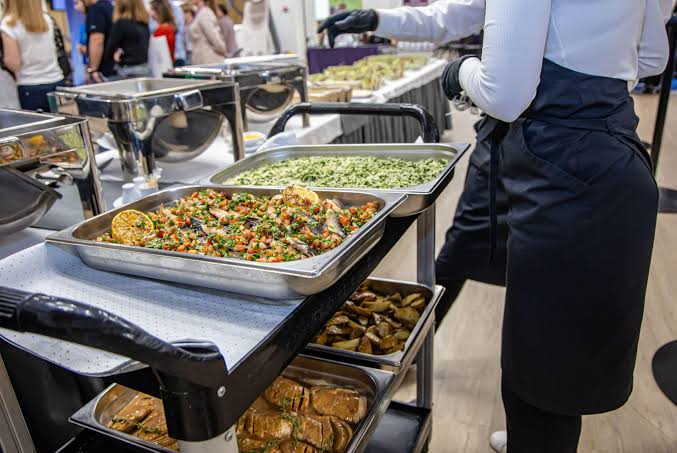
Staffing is where large events quietly fail. Too few servers turns a 30-minute lunch into a 60-minute line, and the meeting after it starts late.
Staffing is one of the clearest differences between corporate and traditional catering.
Use these ratios as your baseline:
- Buffet service: one server per 25 guests, plus one captain for events over 150
- Plated service: one server per 15 guests, plus one runner per 50
- Food stations: one attendant per station, plus one floater per three stations
- Bar service: one bartender per 75 guests for beer and wine, one per 50 for full bar
- Drop-off only: no staff, but add 15 minutes to your setup window
For a 200-person staffed buffet, that math lands at eight servers and one captain. Cutting to five servers saves a few hundred dollars and costs you 20 minutes of everyone’s afternoon.
Double the Lines, Halve the Wait
A single buffet line serves roughly 100 guests in 30 minutes. Two lines running from both sides of the same table cut that nearly in half without adding food cost.
For any event above 100 guests, ask your caterer to set double-sided service. It is the cheapest speed upgrade available.
What Does Large Group Catering Cost in Silicon Valley?
Per-person pricing drops as volume rises, but service level matters more than headcount. A 300-person drop-off can cost less per head than a 60-person plated dinner.
| Format | Typical per-person range | What is included |
|---|---|---|
| Drop-off buffet | $22 to $38 | Food, disposables, setup |
| Staffed buffet | $38 to $65 | Food, service staff, real serviceware |
| Food stations | $48 to $85 | Food, attendants, station setup |
| Plated dinner | $65 to $125 | Food, full service, china, linens |
| Reception, appetizers only | $28 to $55 | Passed and stationed apps, staff |
Ranges reflect Bay Area market conditions and vary by menu, venue, and date. For a deeper breakdown, see our 2026 Silicon Valley corporate catering pricing guide.
Cost pressure is real across the industry. The National Restaurant Association’s 2026 State of the Restaurant Industry report found more than nine in ten operators name food, labor, insurance, and energy as significant challenges. Lock your pricing early.
When Should You Book?
Lead time protects your menu options and your budget. Late bookings get whatever is left.
Booking for December? Our company holiday party catering guide covers holiday deadlines and per-person budgets.
- 50 to 100 guests: three to four weeks
- 100 to 200 guests: six weeks
- 200 to 400 guests: eight weeks
- Any event in November or December: twelve weeks
- Any event needing a venue permit: add two weeks to all of the above
Fourth quarter is the tightest window in the Bay Area. If your event lands between Thanksgiving and New Year’s, treat twelve weeks as the floor.
Building a Menu That Covers Everyone

Dietary needs are no longer an afterthought at corporate events. Plan for them as a percentage of the total menu rather than as a handful of special plates.
A reliable split for a Bay Area corporate audience:
- 35 to 40 percent plant-based or vegetarian
- 20 to 25 percent gluten-free
- At least one nut-free station or clearly separated service
- Halal or kosher-style options when the guest list calls for it
- Clear labeling on every single item
Label by ingredient, not just by category. “Vegetarian” tells a guest with a dairy allergy nothing useful.
Separate the Allergens
Cross-contact is the risk most planners miss. Ask your caterer to serve high-risk allergens from a separate station with dedicated utensils.
Our guide on designing a meal program for every dietary need covers the labeling system in more detail.
Venue Logistics You Need to Confirm
The venue decides what is possible. Confirm these six things in writing before you book a caterer.
- Caterer policy. Is the venue exclusive, preferred-list only, or open to any licensed caterer?
- Kitchen access. Is there a prep space, and does it have refrigeration or hot holding?
- Power. How many dedicated circuits are available near the service area?
- Water. Is there a sink within reasonable distance of the service line?
- Load-in. Where does the truck park, how far is the walk, and is there an elevator?
- Timing. What is the earliest setup time and the hard breakdown deadline?
Off-site events at museums, university buildings, and private venues often require a Temporary Food Facility permit from the County of Santa Clara Department of Environmental Health. Applications are due at least two weeks before the event.
Your Large Event Timeline
Work backward from the event date using this schedule.
| When | What happens |
|---|---|
| 8 weeks out | Confirm venue, lock the caterer, sign the contract |
| 6 weeks out | Finalize menu, confirm service style and staffing |
| 4 weeks out | Submit permits, confirm insurance certificates |
| 2 weeks out | Send preliminary headcount, confirm load-in details |
| 5 days out | Lock final guaranteed headcount |
| 2 days out | Confirm timeline with venue and caterer |
| Event day | Caterer arrives 90 minutes early for staffed service |
Most caterers set the final guaranteed count at five business days. After that point you pay for the number you gave, whether or not everyone shows up.
Frequently Asked Questions
How much food do I order for 100 people?
Order 125 portions for a buffet, since guests average 1.25 servings each. For plated service, order 105 entrees to cover your 100 confirmed guests plus a small buffer.
How many servers do I need for a 200 person event?
Plan on eight servers and one captain for a staffed buffet, or roughly 14 servers plus runners for plated service. Bar service adds three bartenders for beer and wine.
How far in advance should I book catering for a large corporate event?
Six to eight weeks for most events over 100 guests. Move that to twelve weeks for anything scheduled in November or December, when Bay Area capacity is tightest.
Do I need a permit to cater an event at an off-site venue?
Often yes. Events at public venues, museums, and university spaces in Santa Clara County usually require a Temporary Food Facility permit, submitted at least two weeks ahead.
What is the fastest way to serve a large group?
Double-sided buffet lines. Two lines working from opposite sides of the same table serve roughly twice as many guests in the same window with no added food cost.
How do I handle dietary restrictions at a big event?
Build them into the menu percentages rather than treating them as special orders. Aim for 35 to 40 percent plant-based, 20 to 25 percent gluten-free, and label every item by ingredient.
Plan Your Next Large Event With SVCC
Silicon Valley Corporate Catering handles corporate events across Palo Alto, Mountain View, Santa Clara, Sunnyvale, and the wider Bay Area. We manage the headcount math, the staffing, the permits, and the load-in so your team can run the event.
Browse our full catering menu, or request a quote with your date and guest count. For smaller or simpler events, our simple drop-off service covers groups that just need great food delivered on time.